viernes, 5 de julio de 2019

Second and third conditionals

We have been studying conditionals for a couple of weeks, today we are going to see second conditional and third conditional in order to finish the conditional topic.

The Second Conditional
The second conditional uses the past simple after it, then 'would' and the infinitive:
·         if + past simple, ...would + infinitive
(We can use 'were' instead of 'was' with 'I' and 'he/she/it'. This is mostly done in formal writing).
It has two uses.
First, we can use it to talk about things in the future that are probably not going to be true. Maybe I'm imagining some dream for example.
·         If I won the lottery, I would buy a big house.(I probably won't win the lottery)
·         If I met the Queen of England, I would say hello.
·         She would travel all over the world if she were rich.
·         She would pass the exam if she ever studied.(She never studies, so this won't happen)
Second, we can use it to talk about something in the present  which is impossible, because it's not true. Is that clear? Have a look at the examples:
·         If I had his number, I would call him. (I don't have his number now, so it's impossible for me to call him).
·         If I were you, I wouldn't go out with that man.
Difference from first conditional
This kind of conditional sentence is different from the first conditional because this is a lot more unlikely.

For example (second conditional): If I had enough money I would buy a house with twenty bedrooms and a swimming pool (I'm probably not going to have this much money, it's just a dream, not very real)

But (first conditional): If I have enough money, I'll buy some new shoes (It's much more likely that I'll have enough money to buy some shoes)


The Third Conditional
We make the third conditional by using the past perfect after 'if' and then 'would have' and the past participle in the second part of the sentence:
·         if + past perfect, ...would + have + past participle
It talks about the past. It's used to describe a situation that didn't happen, and to imagine the result of this situation.
·         If she had studied, she would have passed the exam (but, really we know she didn't study and so she didn't pass)
·         If I hadn't eaten so much, I wouldn't have felt sick (but I did eat a lot, and so I did feel sick).
·         If we had taken a taxi, we wouldn't have missed the plane
·         She wouldn't have been tired if she had gone to bed earlier
·         She would have become a teacher if she had gone to university
·         He would have been on time for the interview if he had left the house at nine


We have seen all the theory, now let´s practice. Remember practice makes perfect!


Now that we have covered all the conditionals, it is time for a quick recap. 


viernes, 28 de junio de 2019

Just as a recap from the previous lesson, here we have a quick explanation about the zero conditional.


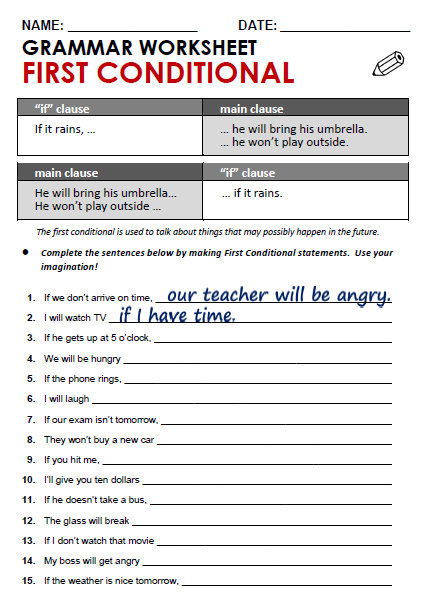
Now, today we are going to learn about the first conditional.


The First Conditional
The first conditional has the present simple after 'if', then the future simple in the other clause:
·         if + present simple, ... will + infinitive
It's used to talk about things which might happen in the future. Of course, we can't know what will happen in the future, but this describes possible things, which could easily come true.
·         If it rains, I won't go to the park.
·         If I study today, I'll go to the party tonight.
·         If I have enough money, I'll buy some new shoes.
·         She'll be late if the train is delayed.
·         She'll miss the bus if she doesn't leave soon.
·         If I see her, I'll tell her.

First vs. Zero Conditional:
The first conditional describes a particular situation, whereas the zero conditional describes what happens in general.

For example (zero conditional): if you sit in the sun, you get burned (here I'm talking about every time a person sits in the sun - the burning is a natural consequence of the sitting)

But (first conditional): if you sit in the sun, you'll get burned (here I'm talking about what will happen today, another day might be different)

 Let´s practice what we have learned. 


Taken from: https://www.perfect-english-grammar.com/first-conditional.html

viernes, 21 de junio de 2019

What are conditionals?

Have you ever had issues with conditionals? Are you totally lost when talking about them?
Well, no worries this post will help you to understand conditionals and how to start using them.

There are four types of conditionals.

ZERO
FIRST
SECOND
THIRD
MIXED


Sometimes we call them 'if clauses'. They describe the result of something that might happen (in the present or future) or might have happened but didn't (in the past) . They are made using different English verb tenses.

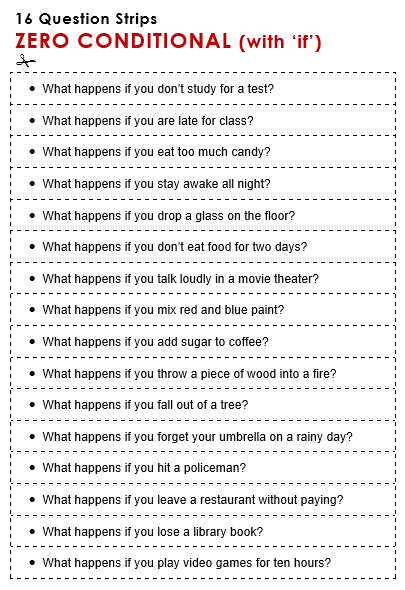
ZERO CONDITIONAL 

Taken from: https://www.youtube.com/watch?v=DwX0nmzsv5w

We can make a zero conditional sentence with two present simple verbs (one in the 'if clause' and one in the 'main clause'):
  • If + present simple, .... present simple.
This conditional is used when the result will always happen. So, if water reaches 100 degrees, it always boils. It's a fact. I'm talking in general, not about one particular situation. The result of the 'if clause' is always the main clause.
The 'if' in this conditional can usually be replaced by 'when' without changing the meaning.
For example: If water reaches 100 degrees, it boils. (It is always true, there can't be a different result sometimes). If I eat peanuts, I am sick. (This is true only for me, maybe, not for everyone, but it's still true that I'm sick every time I eat peanuts)
Here are some more examples:
  • If people eat too much, they get fat.
  • If you touch a fire, you get burned.
  • People die if they don't eat.
  • You get water if you mix hydrogen and oxygen.
  • Snakes bite if they are scared
  • If babies are hungry, they cry
PRACTICE


Taken from: https://www.allthingsgrammar.com/zero-conditional.html
Theory: https://www.perfect-english-grammar.com/zero-conditional.html

Second and third conditionals

We have been studying conditionals for a couple of weeks, t oday we are going to see second conditional and third conditional in order to fi...